
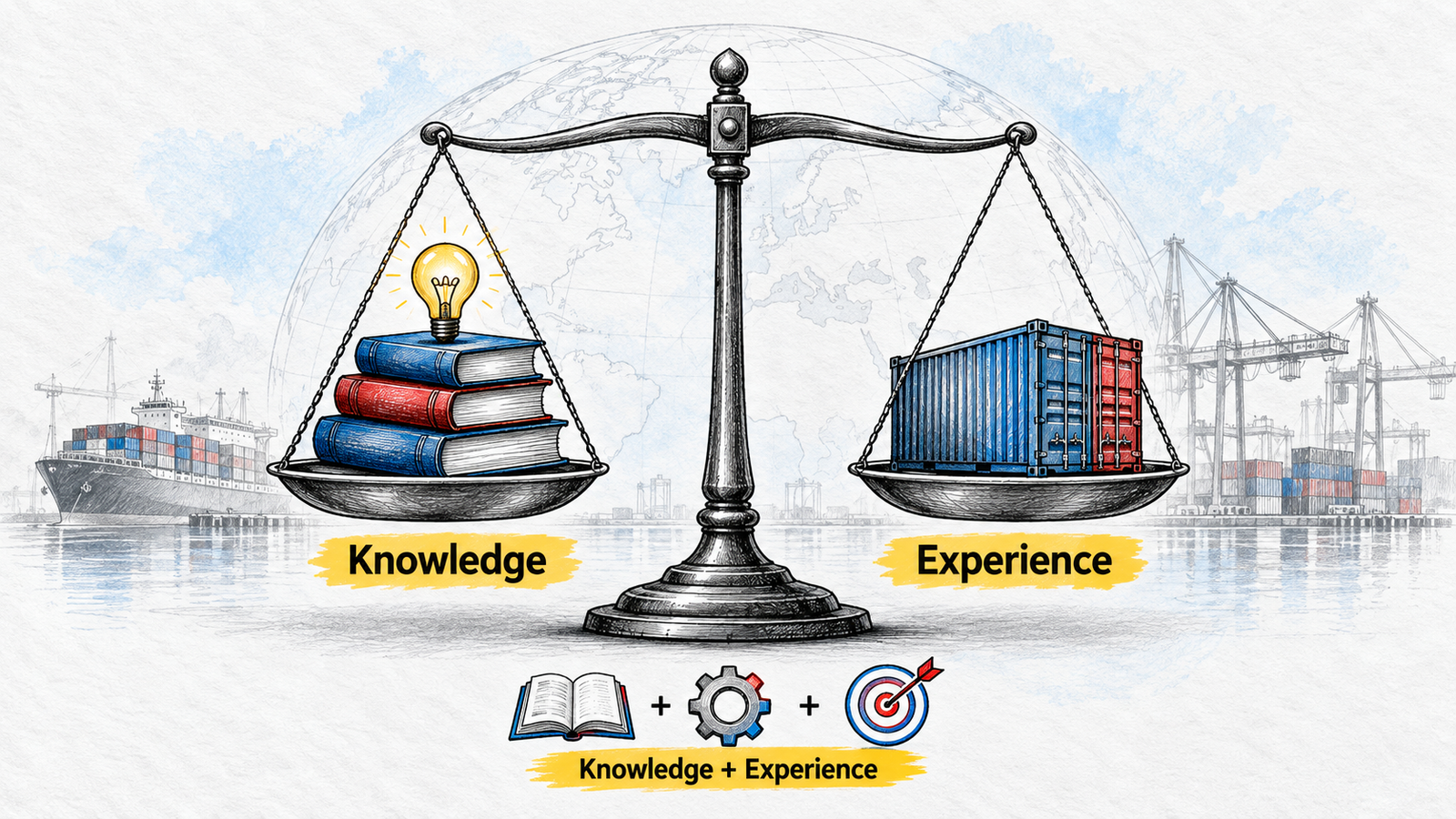
Knowledge and Experience in Logistics: Why Years of Work Are Not Enough
“Forget the theory—we’re practical people!”
This phrase is common in logistics, but it raises an important question: is practical experience alone enough to make the right decisions?
You may have twenty years of experience handling shipments, customers, ports, and transport providers. The risk begins when you believe you no longer need to learn. Professionalism in logistics depends on combining knowledge with practical experience.
Experience Needs a Foundation of Knowledge
Experience teaches you how to manage delays, follow up on documents, negotiate with carriers, and respond under pressure. It also helps you recognise problems before they become serious.
However, repeating a process for years does not automatically make it correct. Sometimes mistakes become habits, and familiar methods continue without anyone asking whether there is a more accurate or cost-effective approach.
Knowledge helps you understand why a decision works, when it applies, and what consequences it may have.
What Should a Logistics Professional Understand?
Behind every shipment are details that affect costs, responsibilities, and delivery. These include:
- Incoterms: Understanding how costs, responsibilities, and risks are allocated between the seller and buyer.
- Bills of Lading (B/L): Understanding their purpose, checking their details, and ensuring they suit the agreed payment and delivery arrangements.
- HS Codes: Understanding product classification and its impact on customs procedures and requirements.
- Chargeable Weight: Understanding how freight charges are calculated, particularly when actual weight differs from volumetric weight.
- Each Party’s Responsibilities: Knowing the roles of the supplier, importer, carrier, freight forwarder, and customs broker.
- Demurrage and Detention: Understanding why these charges arise, monitoring free time, and planning to reduce avoidable costs.
These are more than technical terms. They are tools for preparing clear quotations, checking documents, and making informed decisions.
Practical Work Turns Knowledge into Decisions
Knowing the terminology is only the beginning. Professionalism means applying that knowledge to a real shipment.
You may understand Incoterms, but the practical value lies in assessing which term suits a transaction and explaining its implications to the customer.
You may know how volumetric weight is calculated, but that knowledge becomes useful when you check package dimensions before quoting and identify a cost the customer has overlooked.
Practical work means applying what you know while managing incomplete documents, tight deadlines, changing rates, and unexpected delays. Experience helps you turn knowledge into workable action.
When Can Experience Become a Limitation?
Experience becomes a limitation when it stops someone from asking questions or reviewing their assumptions.
“We have always done it this way” is not enough to justify a decision. Each shipment may involve different cargo, contractual terms, transport routes, and destination requirements.
A professional does not assume that a method that worked before will work every time. They review the details, verify information, and learn from mistakes.
How Can You Develop Your Logistics Skills?
Start with the shipments you handle every day. When an unexpected cost appears, investigate its cause. When a shipment is delayed, identify where the delay occurred and what could improve the process.
Connect learning with practice. Study a concept, then examine how it applies to an actual shipment. Learn from colleagues, consult professional resources, and keep your knowledge current.
Continuous learning strengthens your experience and helps you explain the reasoning behind your decisions.
Knowledge and Experience Build Professionalism
Knowledge gives you a foundation for understanding logistics. Experience helps you manage its real-world challenges.
Measure your progress by more than the years you have spent in the industry. Consider what you have learned, which mistakes you have corrected, and how your decisions have improved.
In logistics, continuous learning is essential. A true professional uses experience to ask better questions and knowledge to make better decisions.